
Medical Equipment Service Contract Management: What Did You Actually Get?
The renewal quote lands on your desk. Finance has one question: what did we get for last year's money?
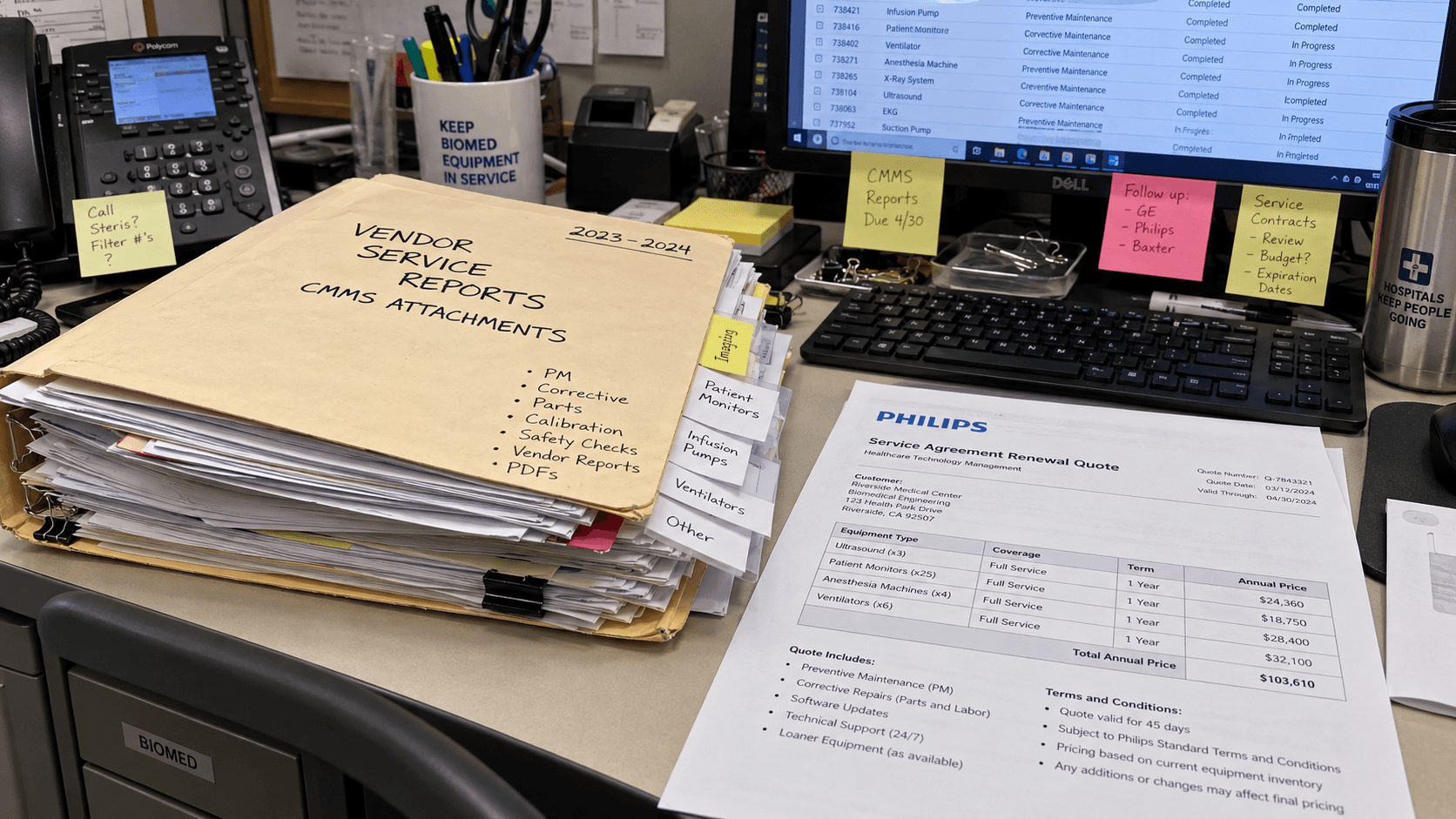
At most hospitals, the honest answer is a folder. Vendor service reports, attached to work orders, mostly unread. The contract says what you were promised. Nothing in one place says what you received.
That is the everyday reality of medical equipment service contract management. And it is not a small corner of the budget.
How big is the service contract problem?
Bigger than most people outside HTM realize. In its 2023 study of service contracts, PartsSource found that a typical hospital manages 146 service contracts, that service contracts make up about half of an HTM department's budget, and that 92% of surveyed hospitals had no consistent procedures to monitor vendor performance against contract terms. PartsSource sells contract management services, so read those as a vendor's findings. They also match what HTM leaders describe.
Now do the math on 146. Even if the average contract ran five years, that is close to 30 renewals a year. Roughly one every two weeks. There is no quiet season. Something is always coming up, and each renewal is decided on whatever the file holds.
And the file is thin. Directors tell us the same thing again and again: finance can give them total vendor spend for the quarter, but not by device and not by department. So the program manages by counting work orders, and the biggest line in the budget is the one nobody can open up.
What does a vendor's service report actually tell you?
Less than you would think. And for a reason.
Under a full-service contract, a field service report often carries the vendor technician's name, the date and the asset. Often no hours, no price, no measurements. We have heard this from several independent sources, and it is the same story every time.
That is not sloppiness. Under a fixed fee, the vendor has no billing reason to write down hours. The fee is already paid, and the report exists to show the visit happened. Hours and parts show up when there is something to bill, like time-and-materials work or an out-of-contract repair. So the paperwork is thinnest exactly where the spend is largest.
Then there is getting the report at all. Some vendors do not send it back automatically. When it does arrive, it gets attached to a work order, and that is where it ends. Stored, never read.
It can even bend your own numbers. When vendor paperwork runs a week behind the visit, work that was done on time can sit in your CMMS looking overdue. Your compliance number ends up measuring a paperwork delay, not a service failure.
What can you check without the vendor's hours?
More than you would think. The better question is not "what did this cost the vendor?" It is "what did we get for what we paid?" Dates and asset IDs answer most of it.
Did the visits happen? Start with what the contract entitles you to. Quarterly PMs on 40 assets is 160 visits a year. Count the reports you actually have. If you hold 100, you have a question worth asking before the renewal, and you found it without reading a single report. The most expensive finding in a contract review is often a document that never arrived.
What did each visit cost? Divide the annual fee by the visits actually delivered. Two numbers, neither from the service report. The fewer visits delivered, the sharper that number gets.
Were they on time? Fault reported to vendor on site. Scheduled PM date to actual PM date. The same asset coming back inside a month. Every one of those comes from dates, and even the thinnest report has a date.
None of this is about catching anyone. Plenty of vendors do excellent work, and a clean record of delivered visits is the best thing a good vendor can bring to a renewal. The point is to know what you received, whoever did the work.
Should you ask vendors for more detail?
Yes. But pick your reason carefully.
Asking a vendor to report its hours under a full-service contract can read as asking them to build a case against themselves, and often nothing in the agreement obliges them to.
The stronger ask is also the true one: you need the detail for your own records. Accreditation still expects you to show how a device was maintained, whoever maintained it. On the Joint Commission's Accreditation 360 changes, Matt Baretich told TechNation that no HTM requirements were eliminated, and the article's own bottom line is being able to show a surveyor exactly how a given device was maintained. A vendor-serviced device does not get a pass because someone else held the screwdriver.
The second moment is the renewal itself. With one coming up every couple of weeks, you get a steady run of chances to write reporting into the next agreement: what the report must contain, and when it must arrive.
Where does your own team fit in?
Every in-house versus vendor conversation needs two numbers. You now have a way to get the vendor's: the fee divided by the visits delivered. The other number is yours. What did your own team's work on the same kind of equipment actually involve?
That answer lives in your own work orders, and too often it has the same problem as the vendor's report. It gets written at the end of the shift, from memory, in a line or two. If your side of the comparison is thin, the comparison is a guess. Finance can tell.
That is the part Leera AI works on. Technicians describe the repair out loud while they do it, Leera AI writes the work order as the work happens, the technician reviews and owns it, and it syncs to your CMMS via API. The vendor's report is only half the comparison. Leera AI makes sure your half is not the weak one.
FAQ
What is medical equipment service contract management? It is the work of choosing, tracking and renewing the agreements under which manufacturers and independent service organizations maintain a hospital's equipment. In practice it means knowing what each contract entitles you to, what was actually delivered, and when each one comes up for renewal.
How many service contracts does a hospital manage? PartsSource's 2023 study put the typical hospital at 146 service contracts, making up about half of the HTM budget. With a portfolio that size, renewals arrive all year rather than once.
What should a vendor's field service report include? Enough for someone who was not there to know what happened: the asset, the date, the work performed, the results of any tests, and whether the device went back into service. Hours and parts often appear only on billable work. If you need more, the cleanest time to require it is at renewal.
How do you know if a service contract is worth it? Compare what the contract entitles you to against what you can show was delivered: visits completed, cost per delivered visit, and response and PM timing. Then set that against what the same work involves in-house. Most of the vendor side comes from dates and asset IDs you already hold.
Dima Okhrimchuk is the founder of Leera AI, which builds voice-first documentation for HTM teams. Leera AI is built in the field with HTM teams at major US health systems.