
The HTM Leader's Guide to CMMS Data Quality
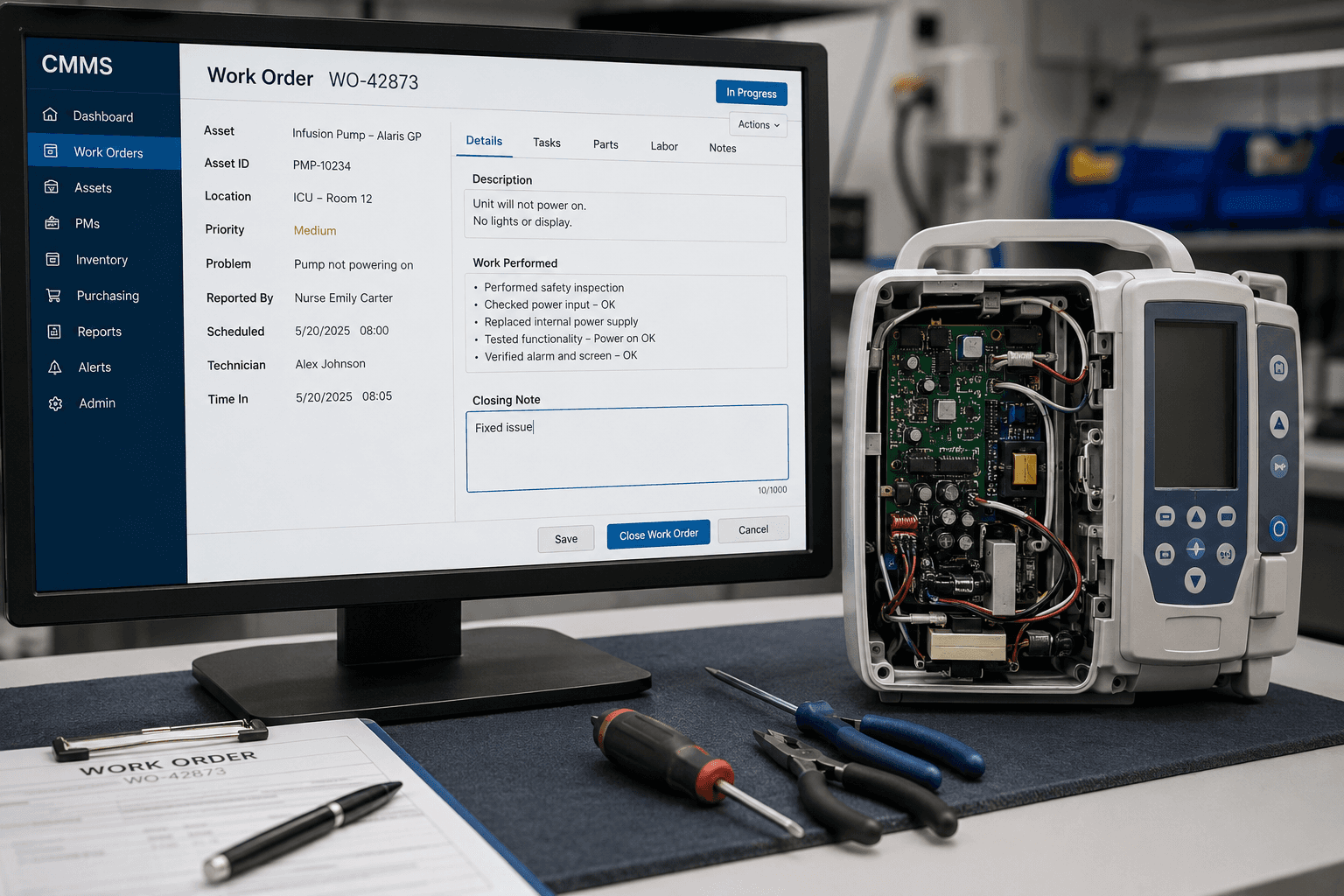
Every HTM director has had this moment. You pull a report for a capital request, a staffing case, or a survey prep, and you already know you can't fully trust it. The inventory is solid. The PM completion rate looks fine. But the repair history is thin, the failure codes are guesses, and half the closing notes say some version of "Good to go."
The frustrating part is that you have already done everything the playbook says. This article is about why the playbook keeps failing, and where the fix actually lives.
Why is CMMS data quality still a problem?
Not because anyone stopped caring. Ted Cohen and Matt Baretich, who wrote the AAMI book on CMMS management, put it plainly in 24x7 Magazine: a CMMS is like a medical record for equipment, garbage in means garbage out, and in their consulting work they commonly see CMMS data so incomplete it makes useful reports impossible. That was 2017. Ask any HTM consultant today and you will hear the same thing.
Monty Gonzales made the same point from the bench side in AAMI News: the permanent record of skilled work often comes down to a few words, and everything downstream inherits that.
So the problem is well known, well documented, and old. Which raises the real question.
Haven't we already tried to fix this?
Yes. Twice over, and mostly from the top.
Departments attacked it with process: note templates, mandatory fields, monthly audits, manager sign-off before a work order closes, a sterner slide at the staff meeting. Every director reading this has run some version of that play.
The industry attacked it with standards. Six competing CMMS vendors sat down under AAMI and agreed on standardized failure codes and work order types, which almost never happens in any industry. The white papers are real, practical work, and worth reading. TechNation covered why it matters: if everyone records data the same way, benchmarking finally becomes possible.
And yet the data is still thin. Because a standard defines the buckets. It cannot fill them. If the work order underneath is a guess, the standardized failure code is a guess wearing a uniform. Standardized garbage is still garbage, just easier to aggregate.
Where does bad CMMS data actually come from?
Here is the part the playbook misses: data quality is decided in one place, at the bench, in the minutes during and right after the work. Everything else operates too late.
Picture the moment. A tech has both hands inside an infusion pump. The error code that appeared twice and vanished, the part that looked worn but tested fine, the hunch about a second pump on the same floor: all of that exists right now, in the tech's head. Then five more problems land on the bench. The documentation gets written at 4:30 pm, from memory, about a 9 am repair.
That is not a record. It is a reconstruction. And reconstructions flatten everything into "replaced part, tested, good to go."
This is not a technician problem. Nobody becomes a biomed because they love typing, and no amount of discipline lets a person hold six work orders' worth of error codes and test values in memory for eight hours. Asking someone to do skilled work with both hands and then write it up later from a keyboard is a workflow designed to produce thin data. The best tech in your shop cannot out-diligence that design.
That is also why every top-down fix has disappointed. Templates, required fields, and audits all touch the record after the detail is already gone. You are formatting a reconstruction. You cannot review your way back to information that was never captured.
One story from the field, anonymized: an HTM director we worked with pulled several years of repair history on an infusion pump fleet to build a replacement case. The majority of failure codes in the export said "other." The history existed, the fleet was aging, the techs had done the work well, and the data could not tell the story. The capital request went in on anecdotes.
What does thin CMMS data cost an HTM department?
More than a bad report. Three costs compound quietly.
Benchmarking stays out of reach. The AAMI Benchmarking Guide gives the profession a common yardstick, but comparing failure rates across sites only works if the failure data means what it says. Thin inputs, meaningless comparisons.
Your defensible positions get weaker. AEM intervals, staffing cases, and incident reviews all stand on work order history. When the record says "Good to go," your liability exposure is written one work order at a time, and your budget case is written the same way.
And every AI tool being pitched to you right now inherits the problem. Predictive maintenance, capital planning, failure forecasting: all of it is a multiplier on your work order history. Clean history, useful predictions. Ten years of thin notes, confident guessing with a dashboard.
What actually improves CMMS data quality?
Three moves, in order of effort.
First, keep the hygiene layer. Cohen and Baretich's fundamentals still apply: field definitions, referential integrity, error checking at data entry, periodic audits. This is necessary. It is just not sufficient, because it governs the structure of the record, not the substance.
Second, measure your capture gap. Pick a recent week and sample 20-30 closed repair work orders. Count how many contain a real problem-cause-remedy narrative, a failure code that is not a default, and labor time that looks like a measurement rather than a round number. That percentage is your data quality, whatever the completion dashboard says. In our field observations across HTM teams at major US health systems, most departments that run this check for the first time are surprised, and not pleasantly.
Third, fix the capture moment itself. The detail dies between the hands-on work and the keyboard, so the fix is to close that gap: capture the work while it happens instead of reconstructing it afterward. That is the problem we build for at Leera, ambient voice documentation that listens while the tech works, hands-free, and drafts the work order for review, built in the field with HTM teams at major US health systems. How that works end to end is covered in our guide to voice documentation for CMMS.
However you solve it, the principle holds: quality is created at capture, not at review. Aim your next data quality initiative at the moment the data is born.
FAQ
What is CMMS data quality? The degree to which the records in a computerized maintenance management system are complete, accurate, and consistent enough to support real decisions: benchmarking, AEM justification, capital planning, and staffing cases. High completion rates alone do not mean high data quality; a closed work order that says "Good to go" is complete and still tells you nothing.
Why do work order notes stay thin even with templates and mandatory fields? Because templates and required fields operate after the capture moment. Most documentation is written from memory at the end of a shift, and reconstruction flattens detail no matter how good the form is. The fix is capturing information during the work, not adding more structure afterward.
How do I measure my department's CMMS data quality? Sample 30 recent repair work orders and score them on three checks: a real problem-cause-remedy narrative, a specific failure code rather than a default, and labor time that reflects the actual repair. The share that passes all three is a more honest quality metric than any completion dashboard.
Does standardizing failure codes fix CMMS data quality? It helps, and the AAMI CMMS Collaborative's standardized codes are worth adopting. But a standard defines categories; it cannot make the underlying record accurate. If the work order is a reconstruction, the standardized code is a better-labeled guess.
Dima Okhrimchuk, CEO & Founder, Leera AI